
Christianity and Veganism - A Christian perspective on veganism
- The Floating Man

- 17 okt 2021
- 8 minuten om te lezen
First some general comments to start with: No religious text in the christian tradition says we need to eat animals. It is no necessity, so we can choose not to. If we choose to do something, we can be held morally accountable for doing so. So how do you morally justify eating animals as a Christian? Normally it partly depends upon necessity in determining whether it is moral. When there is no physical necessity and no religious necessity in the form of a commandment from God to eat animals, we can't justify it on the basis of necessity and I would argue that we can't justify it at all.
What is also important to keep in mind is that in the time of Jezus or Mohammed, it might often have been necessary, but that was a completely different world. We nowadays can easily get all the nutrients we need from plant based sources. So it is irrelevant what happened in these times when we want to determine what we should be doing now. The fact that Jezus might have eaten fish does not mean we can do so as well. Mohammed married a six year old, can we do that as well?
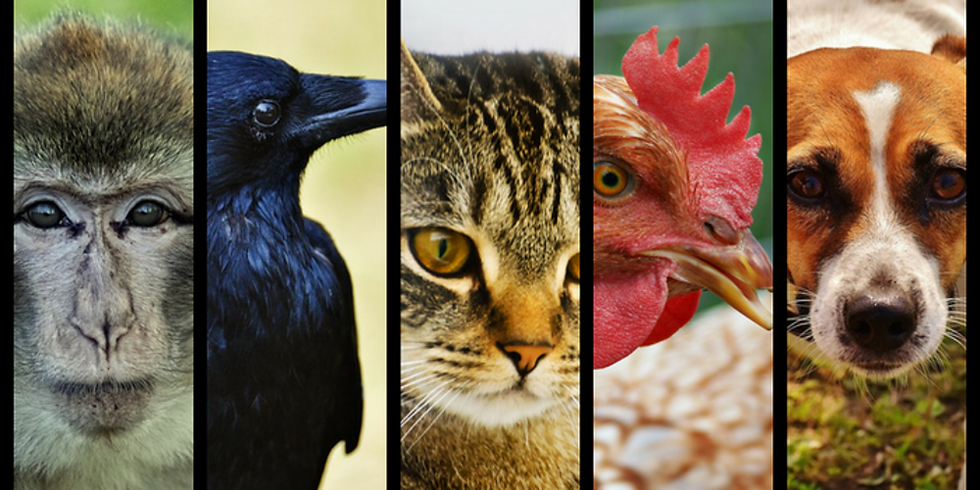
Assuming God designed this world and thus also the animals in them, along with the idea that God is good and compassionate in nature, it does not make sense that he would have made them for us to eat. For animals are made sentient; they can feel, they can suffer in most likely the same way we can. They have the desire to live and a fear of death. When we eat them, they will go through all of this fear, pain and suffering in the process of becoming our food. So it does not make sense that God would have made them for us to eat, since then he consciously made them in such a way that they would suffer immensely for this, which would make God an evil and sadistic being. Something which contradicts everything Jezus teaches us about God. So the only logical conclusion can be that animals are not made as food for us. And here I want to quote Genesis 1:29 which supports this idea:
"And God said, Behold, I have given you every herb bearing seed, which is upon the face of all the earth, and every tree, in which is the fruit of a tree yielding seed; to you it shall be for meat."
You might respond by saying that God gave us dominion over the animals as said in Genesis 1:26:
"And God said, Let us make man in our image, after our likeness: and let them have dominion over the fish of the sea, and over the fowl of the air, and over the cattle, and over all the earth, and over every creeping thing that creepeth upon the earth."
But it should be clear that nowhere in this passage it says we should eat them, nor that we could do with them as we please. There is no way in which this negates the problem of all the suffering God would cause by choice if animals were here for us to eat. Adam and Eve did not eat animals as far as I am aware either. I think it is more likely that this passage suggests that we have the power and probably also the responsibility to take care of the earth and its inhabitants. We have the power to destroy and the power to create, to nurture, but the choice is ours which one will be dominant. This idea is supported in Genesis 2:15, as God instructed Adam to “till” and “keep” the Garden of Eden, so we may see caring for God’s Creation as our sacred task. Adam’s “dominion” over animals, I believe, conveys sacred stewardship, since God immediately after-wards prescribed a vegetarian diet (1:29–30) in a world God found “very good” (1:31). Created in God’s image of love (1 John 4:8), we are called to be care-takers of God’s Creation, not tyrants over God’s creatures. Jezus is presented as the perfect example of a good shepherd. In John 10:11 it says: "I am the good shepherd. The good shepherd lays down his life for the sheep." It is not the other way around, it never has been and it will never be. So being a shepherd, having dominion and stewardship over a certain group means caretaking.
From this idea it would follow that we should protect the animals, the forests and the oceans. We should be the caretakers of this world. We have the power to be so, but as always with power, it can also be misused. The power can be used to exploit those who are at our mercy. And sadly that is what seems to be what is happening. Here I would like to quote from the book 'The unbearable lightness of being':
"True human goodness, in all its purity and freedom, can come to the fore only when its recipient has no power. Mankind's true moral test, its fundamental test (which lies deeply buried from view), consists of its attitude towards who are at its mercy: animals. And in this respect mankind has suffered a fundamental débâcle, a débâcle so fundamental that all others stem from it."
In line with this I would argue that from an environmental perspective we should also nurture this world and take care of the animals, not eat them, if we are to care about God's creation. For now we are destroying it. We are destroying the habitat of the natural world and with that our own. The animal industry is the number one contributor to climate change and habitat destruction. We are killing immense amounts of animals, farmed and wild, for which we destroy vast amounts of nature, from forests to coral reefs to feed our hunger for luxury and animal products. All of which are also creations of God, and as a consequence it will cause immense amounts of suffering to humans now and in the future, the loss of many lives due to climate change and perhaps even the loss of all human life. Do you, as a Christian, not have a responsibility or at least a desire to protect and nurture God's creation?
If you have either one of these, then again it would be a logical conclusion to not eat any animals or their products such as dairy or eggs, since these industries are indistinguishable and cause the same amount, if not more, harm then meat production. I remember reading a quote from Victor Hugo, a famous French poet from the 19th century who wrote: “Animals run no risk of going to hell, they are there already." For many of these animals we are the devils on this earth. And the situation for animals certainly has not gotten any better since he wrote this. From our duty as caretakers or shepherds it should not only follow that we don't consume any animal products, for that would be the zero-line so to say. We don't harm them, but we certainly are not taking care of them either, we are not helping them by not eating them, we only are not hurting them ourselves. So it should also follow that we actively try to take care of them, to help them. One way of doing this is by being a vegan activist. That is what I am doing here. I am trying to help these animals because I have the power to do so, where they can't do it themselves. I will speak up for them because their voices, their screams, are not heard.
How could God be happy with us, or even wanting us to destroy the world he gave us? It does not make any sense. How would you feel if you gave your child a birthday present you made yourself, for example a piano, and the child thanked you by destroying it, by hitting it with a hammer until it was smashed to pieces? After you said "take good care of this my child, I made this especially for you so you can enjoy it and pass it on to your children and their children after them". That is how the situation looks like to me. I can not imagine God wanted us to do that. I would expect God to feel frustration, anger and despair when he sees us destroy what he made for us in front of his very eyes.
Is there any reason the commandment of not murdering should not apply to animals? When God told Mozes "One should not kill", did he add "except if it is an animal"? Or take the golden rule as formulated in Matt. 7:12 "treat others as you would like others to treat you", should this not also guide how we treat animals? In Matt. 5:7 Jezus said "Blessed are the merciful”, yet no mercy is shown for nearly all farmed animals. God cares for animals. Genesis 1:21–22 relates that, after God
created animals, God blessed them and called them “good.” The Bible
repeatedly describes God’s concern for animals and forbids cruelty. Further evidence that we should consider animals as inherently valuable comes from Genesis 2:18–19, which indicates that God made animals as Adam’s helpers and companions: “Then the Lord God said, ‘It is not good that man should be alone; I will make him a helper fit for him.’ So out of the ground the Lord God formed every beast of the field and every bird of the air, and brought them to the man to see what he would call them…” (RSV). Adam named the animals, which shows concern and friendship. We don’t name the animals we eat.
God endowed pigs, cattle, sheep, and all farmed animals with their own desires and needs, which is apparent when these animals are given an opportunity to enjoy life. For example, pigs are as curious, social, and intelligent as cats or dogs. Pigs can even play some video games better than monkeys. Similarly, chickens enjoy one another’s company and like to play, dust bathe, and forage for food. Jesus compared his love for us to a hen’s love for her chicks (Luke 13:34)
But you might reject it by saying that God allowed Noah to eat meat as said in Genesis 9:3 “Everything that lives and moves about will be food for you. Just as I gave you the green plants, I now give you everything." But we should remember that at this time nearly all vegetation was destroyed by the flood, so there was not much to eat. This seems to come back to my initial argument that necessity might justify doing something. Here it is portrayed as necessary for Noah and his children to eat animals to survive. But does that mean we should be able to do so as well? The answer is both yes and no, depending on whether you also live in a situation in which it is necessary. For most of us it probably is not necessary and thus we should not be doing it, since all that is described above still stands. From the suffering of the animals and the destruction of this world to our duty as caretakers. Along with the fact that even though it seems God had a change of mind and permitted it after all, he does not command us to and thus it is still a choice. A choice between compassion and kindness on the one hand and cruelty and mercilessness on the other.
I am in no position to tell Christians what their faith should be, but I think I can show what the bible says and draw the logical conclusions from that and by doing that I think Christians should themselves also come to the conclusion that being a vegan is a great way to enjoy our life om earth while respecting and taking care of God's creation.
----------------------------------------------------------------------------------------------------
Here are some resources from christians who are vegan and share their thoughts, such as these websites:
- https://www.all-creatures.org/replies.htm
- https://christianveganism.com
- https://www.todayschristianwoman.com/articles/2013/november/
why-im-christian-vegan.html
- https://christianveg.org/honoring.htm
Or these youtube videos:


Opmerkingen